
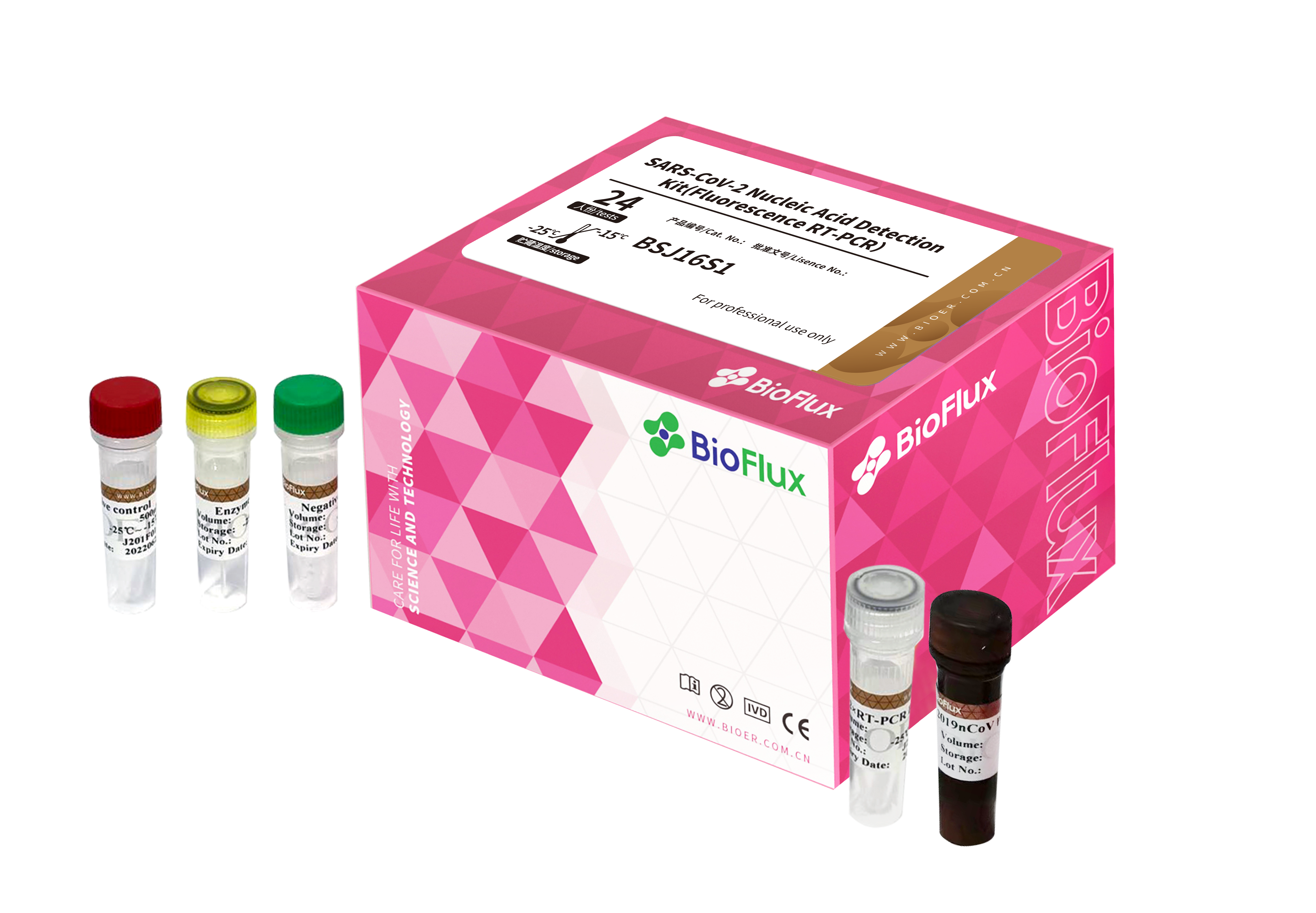
SARS-COV-2 Nucleic Acid Detection Kit (Fluorescence RT-PCR)
This kit is used for the qualitative detection of the SARS-CoV-2 nucleic acid in specimens of nasopharyngeal swabs, oropharyngeal swabs and sputum specimens from suspected cases. This kit selects the novel coronavirus 2019-nCoV Orf1ab and N gene fragments for primer and fluorescent probe design, and has excellent specificity. During the detection process, the human β-Globin gene is introduced as non-competitive internal control which can monitor the quality of the entire extraction and detection process to prevent invalid detection.
Details
Product Description
This product selects the ORFlab (FAM) and N gene (HEX) regions of SARS-CoV-2, and designs three sets of primers and fluorescent probes. The three sets of primers and probes can specifically bind to the tanget sequences. Whenthe RT-PCR amplification reaction is performed, the fluorescent signal (s) can bedetected by a full-automatic fluorescent PCR detector to realize real-time online monitoring of the RT-PCR reaction. In order to control the entire extraction and detection process, human gene was act as a non-competitive internal control duringthe extraction and detection process.
Product Features
- Duplex detection of ORF1ab and N genes
Enhances detection specificity and accuracy.
- Efficient hot-start enzyme
Provides strong stability and reliable amplification performance.
- Built-in internal control
Ensures result reliability and avoids false negatives.
- High analytical sensitivity
Detects as low as 500 copies/mL of viral RNA.
Application Field
Respiratory infection disease detection
Storage Conditions
-25℃~-15℃
FAQ
A1: (1) Primers Check if the artificially synthesized primers have degraded due to improper storage conditions; Whether the primer design is reasonable, BLAST can be used to check primer specificity or redesign primers. (2) Template Long term storage and repeated freezing and thawing can lead to template breakage, ring opening, or degradation. Freshly prepared DNA double strands should be used as templates; If the template GC content is too high, it will cause the double stranded DNA to be unable to open. At this time, adding PCR Enhancer (item number P021) can effectively reduce the unwinding temperature; If the template is cDNA, it is necessary to confirm the purity and integrity of the RNA used for reverse transcription. (3) Enzymes The enzymes used in the reaction are inactivated due to improper storage or transportation. It is recommended to replace them with new enzymes or re experiment with enzymes from another source. (4) Amplification system The reaction system configuration is incorrect, it is recommended to repeat the experiment. (5) Reaction program Check if the denaturation temperature is accurate and if the PCR instrument indicates a temperature that matches the actual temperature. If the temperature is too high, the enzyme will quickly become inactive in the first few cycles, while if the temperature is too low, the template denaturation will not be complete; The annealing temperature is not suitable. A gradient can be set for the annealing temperature to explore a suitable annealing temperature; Set annealing temperature based on primer Tm value, such as primer Tm value≥ At 72 ℃, the annealing step can be removed and the subsequent extension step (two-step PCR) can be carried out directly.
Specification
| Sample type | nasopharyngeal swab |
|---|---|
| Sensitivity | 500 copies/mL |
| Accuracy | CV<5% |
| Detectability | Qualitative detection SARS-COV-2 Nucleic Acid |
| Support Instrument | Bioer’s Fluorescence Quantitative Detection System, LineGene 9600 Plus (FQD-96A) and QuantGene 9600(FQD-96C) |
Ordering
| Cat# | Product Name | Packing size |
|---|---|---|
| BSJ16S1 | SARS-CoV-2 Nucleic Acid Detection Kit (Fluorescence RT-PCR) | 24T |
| BSJ16M1 | SARS-CoV-2 Nucleic Acid Detection Kit (Fluorescence RT-PCR) | 48T |
| BSJ16L1 | SARS-CoV-2 Nucleic Acid Detection Kit (Fluorescence RT-PCR) | 500T |