
Avian Influenza Virus H5N8 Subtype Nucleic Acid Detection Kit (Fluorescence PCR)
Details
Product Description
The kit selects specific conserved regions of AIV H5N8 subtype to design primers and probes. The detection system uses two different fluorophores to independently detect AIV H5 subtype target gene (FAM channel) and AIV N8 subtype target gene (HEX channel).
Product Features
- Sample Types: Throat swabs, cloacal swabs, serum, and lung tissue.
- Ultra-High Sensitivity: Detection limit as low as 500 copies/mL.
- High Specificity: Enables accurate differentiation of avian influenza virus subtypes while maintaining excellent negative results for influenza B virus testing.
- Broad Compatibility: Compatible with a wide range of commercially available real-time PCR systems.
- Easy Operation & Rapid Results: The ready-to-use premix format simplifies workflow with fewer components, and the complete PCR reaction can be completed within 1 hour.
Application Field
This kit can be used for qualitative testing of avian influenza virus (AIV) H5N8 subtype in throat swabs, cloaca swabs, serum and lung tissue of suspected infection or other animals that require the diagnosis or differential diagnosis of avian influenza virus H5N8 subtype infection (chicken, duck, goose, etc.).
Application Cases
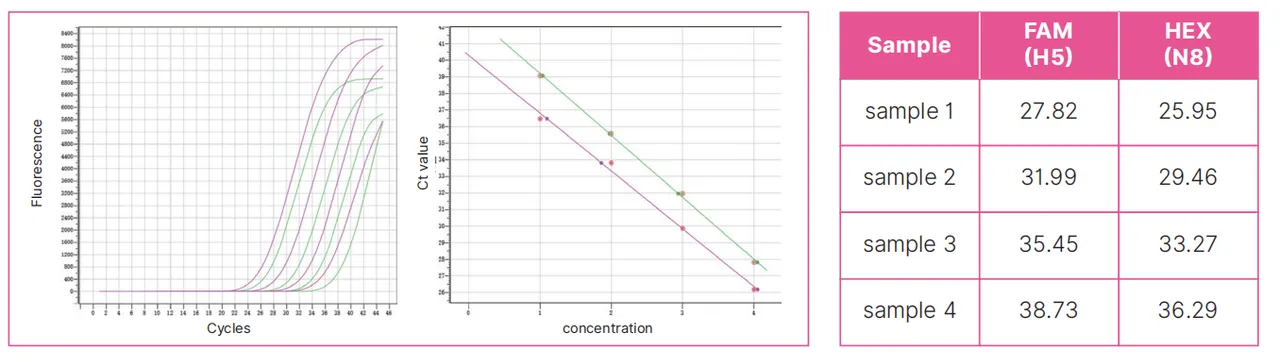
Using this kit to detect the H5N8 positive sample and make standard curve, which find the correlation coefficients of the Ct values detected by each subtype are above 0.995, indicating that the kit has a good linear relationship and high PCR efficiency. The results are as follows:
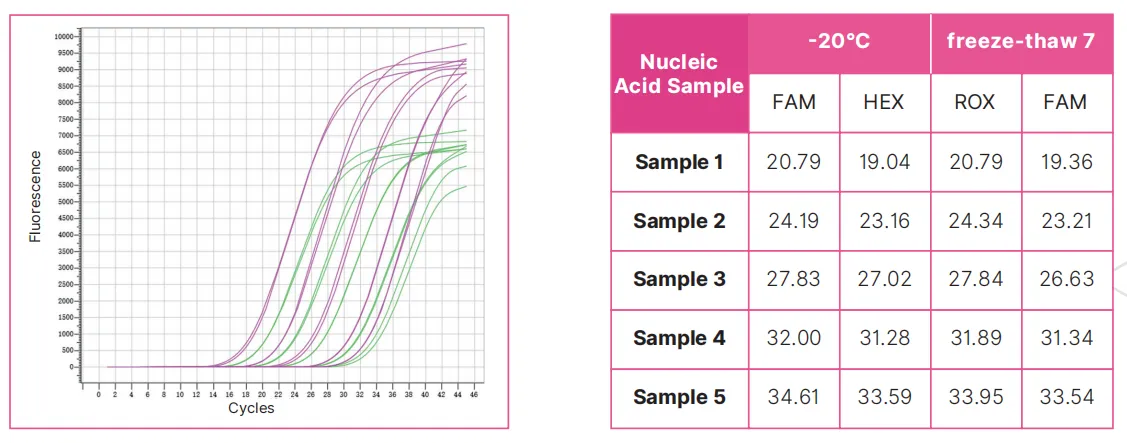
The kit was stored at -20ºC and 37ºC for 7 days, and was taken out to detect positive samples of different concentrations. The results showed that the kits being stored at 37ºC for 7 days, compared to the kits being stored at -20ºC to detected samples of different concentrations at the same time, there was no significant difference in the detection effect, indicating that the stability of the kit was good. The detection result is as follows:
Storage Conditions
1. The kit need to be transported under freezing conditions.
2. The kit should be stored at -25℃~-15℃ away from light, and avoid repeated freeze-thaw more than 5 times.
3. The kit can be stored for up to 12 months if all components are kept in the manner above. (Please use the kit in the period of validity).
Ordering
| Cat# | Product Name | Packing size |
|---|---|---|
| BSL54S1 | Avian Influenza Virus H5N8 Subtype Nucleic Acid Detection Kit (Fluorescence PCR) | 25T |
| BSL54M1 | Avian Influenza Virus H5N8 Subtype Nucleic Acid Detection Kit (Fluorescence PCR) | 50T |
Related Products
You May Also Like
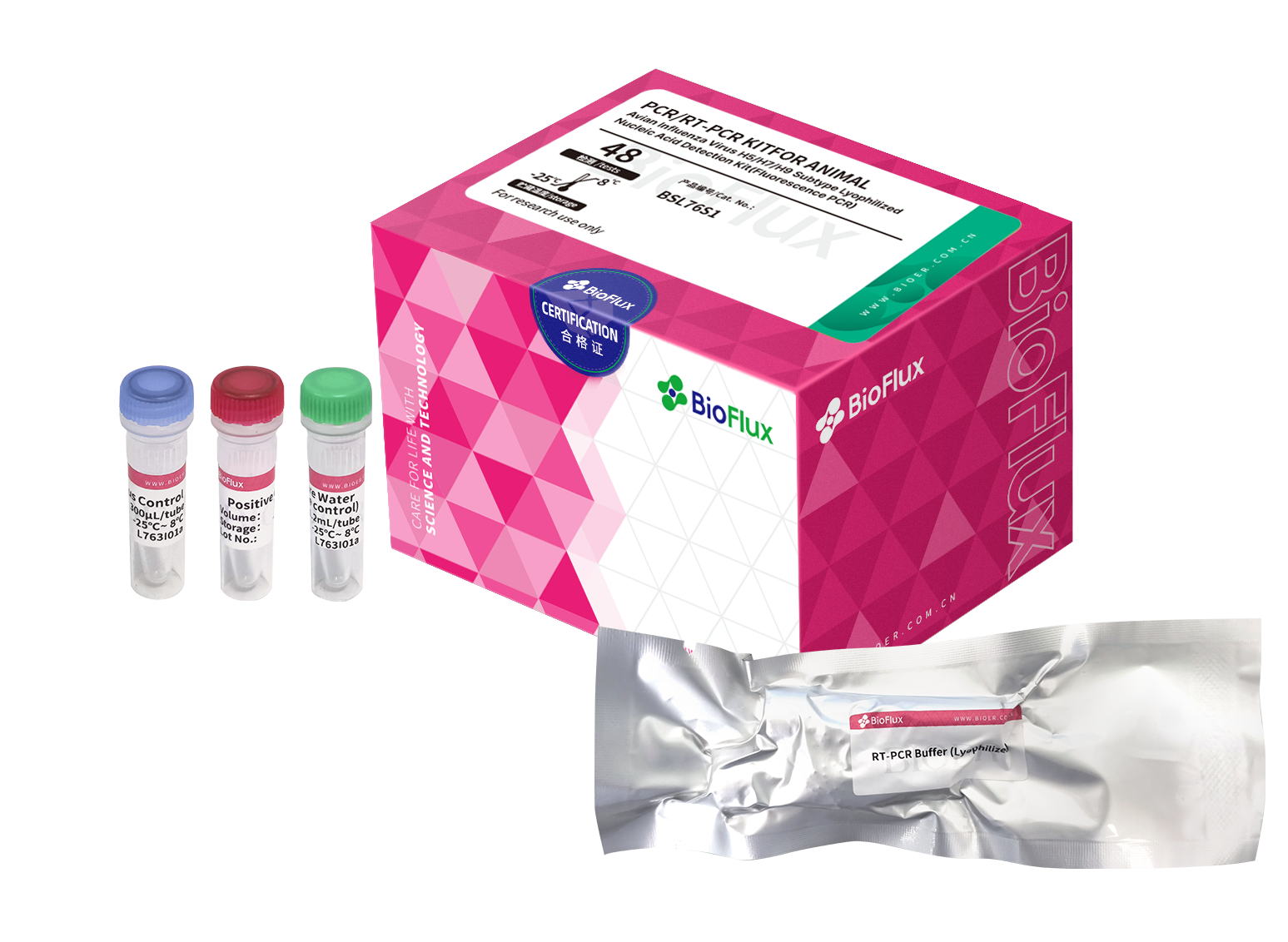
Avian Influenza Virus H5/H7/H9 Subtype Lyophilized Nucleic Acid Detection Kit (Fluorescence PCR)
Avian Influenza Virus (AIV) is a kind of influenza A virus, which is listed as a severe infectious disease of type A by the World Organization for Animal Health (Founded as OIE). According to the antigenicity of the outer membrane hemagglutinin (H) and neuraminidase (N) proteins, it can be divided into 16 H subtypes (H1-H16) and 9 N subtypes (N1-N9). Among avian influenza viruses, highly pathogenic avian influenza is caused by the H5 and H7 subtypes of influenza A virus, which are highly harmful and have a high mortality rate. Additionally, H5N1, H7N9, and H9N2 can be transmitted to humans. Therefore, if not detected timely, it may result in in heavy losses for farmers and causing significant economic losses to the poultry breeding industry.
Avian Influenza Virus H5N1 Subtype Nucleic Acid Detection Kit (Fluorescence PCR)
Avian influenza virus (AIV) is a type of influenza A virus and is classified as a class A severe infectious disease by the World Organization for Animal Health (OIE). According to the different antigenicity of its outer membrane hemagglutinin (H) and neuraminidase (N) proteins, it can be divided into 16 H subtypes (H1~H16) and 9 N subtypes (N1~N9). Among avian influenza viruses, H5N1, H7N7, and H9N2 can be transmitted to humans, of which H5N1 is highly pathogenic and has a high fatality rate.
Avian Influenza Virus Lyophilized Nucleic Acid Detection Kit (Fluorescence PCR)
Avian influenza (AI) viruses, commonly known as bird flu, are members of the family orthmyxoviridae, Type A which is subdivided into categories (strains) depending on the outer proteins H (Haemagglutinin) and N (Neuraminidase). There are many types of avian influenza, which are all caused by various strains of type A influenza virus (e.g., H5N1, H7N3, H9N2).