
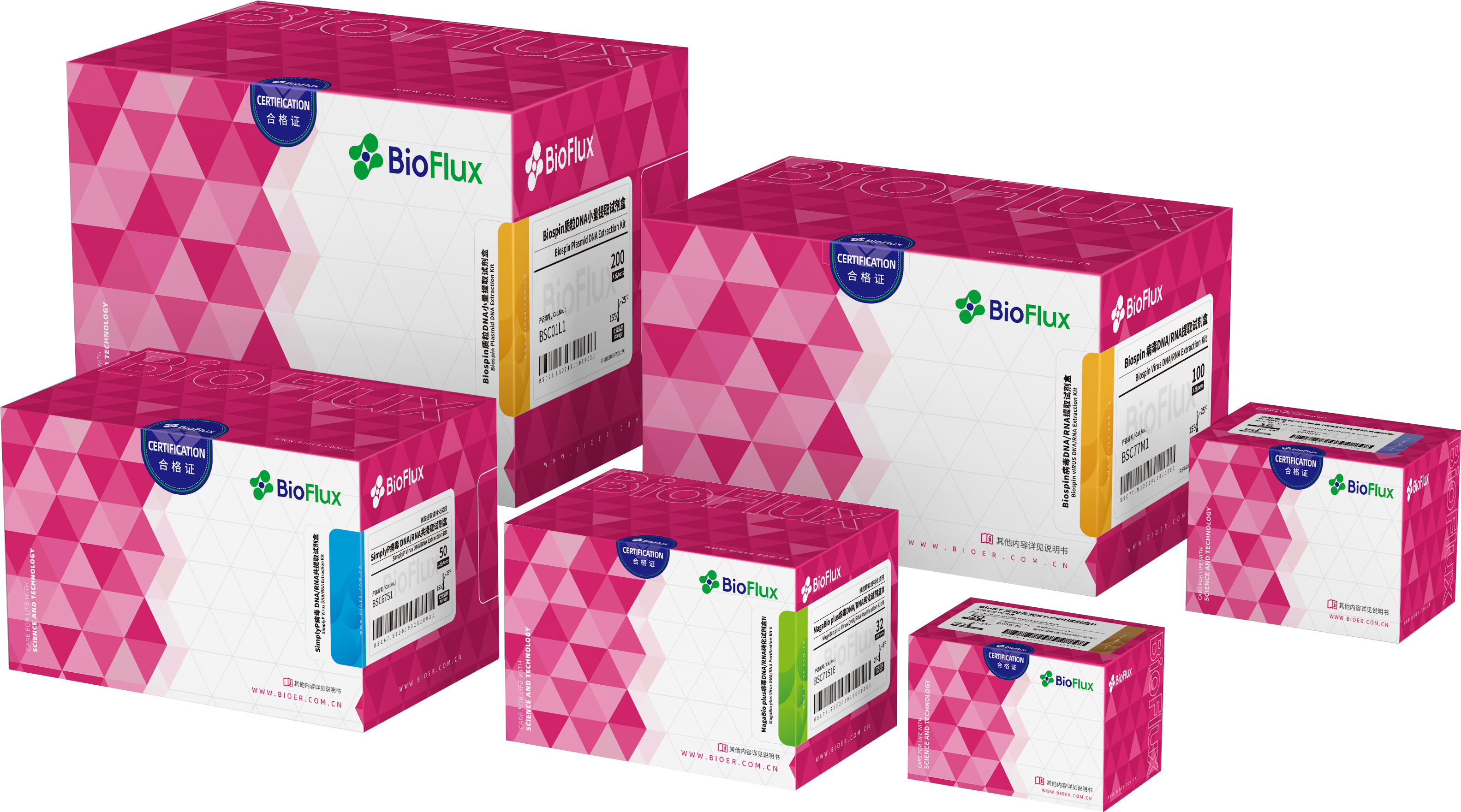
Norovirus/Group A Rotavirus/Enteric Adenovirus Nucleic Acid Detection Kit (Fluorescence PCR)
Details
Product Description
This product selects the VP6 gene (FAM) regions of Group A Rotavirus, Hexongene (HEX) regions of Enteric Adenovirus and ORF1 gene (ROX) regions of Norovirus, and designs four sets of primers and fluorescent probes that cover foursites of the genes. The four sets of primers and probes can specifically bind to thetarget sequences. When the RT-PCR amplification reaction is performed, thefluorescent signal (s) can be detected by a full-automatic fluorescent PCR detectorto realize real-time online monitoring of the RT-PCR reaction. In order to controlthe entire extraction and detection process, human gene (Cy5) was act as anon-competitive internal control during the extraction and detection process.
Product Features
- Rapid: It can accurately detected norovirus, group A rotavirus and enteric adenovirus in 35 minutes together with Bioer FQD qPCR instruments.
- High sensitivity: 500 copies/mL.
- Strong applicability: Applicable to human stool specimens.
- High accuracy: Results from reference materials: positive coincidence rate 100%, negative coincidence rate 100%.
Application Field
The kit is used for the auxiliary diagnosis and epidemiologicalsurveillance of Norovirus, Group A Rotavirus and Enteric Adenovirus infection,cannot be used as the basis for the diagnosis or exclusion of cases alone.
Storage Conditions
1. The kit should be stored at -25°C - -15°C away from light and avoid repeated freeze-thaw.
2. The kit can be stored for 3 days at 2-8 °C after opening.
3. The kit can be stored for up to 12 months if all components are kept in the manner above. Do not use after the stated expiry date.
4. The kit can be transported in foam box sealed with ice bags or dry ice under 8 °C.
Related Products
You May Also Like
Enterovirus Universal Nucleic Acid Detection Kit (Fluorescent PCR)
Enterovirus belongs to the genus Enterovirus in the family Picornaviridae, consisting of a single-stranded, positive-sense RNA genome approximately 7.2–8.4 kb in length. The genome is divided into three regions, with conserved non-coding regions at both ends, showing significant homology among enteroviruses. The 5' untranslated region is often used as the target gene for universal detection of enterovirus.
Vibrio Cholerae Nucleic Acid Detection Kit (Fluorescence PCR)
Vibrio cholerae is a gram-negative, comma-shaped bacterium that is the causative agent of cholera, a severe diarrheal illness. This pathogen primarily thrives in aquatic environments such as brackish water and estuaries. V. cholerae is categorized into over 200 serogroups, but only O1 and O139 are known to cause cholera outbreaks. The bacterium produces cholera toxin (CT), which disrupts the normal ion transport in the intestines, leading to the characteristic watery diarrhea, also known as "rice-water stool."
Enterovirus Universal, Enterovirus 71, Coxsackievirus A6, Coxsackievirus A10 and Coxsackievirus A16 Nucleic Acid Detection Kit (Fluorescent PCR)
Hand-foot-mouth disease (HFMD) is a common infectious disease caused by enterovirus infection, characterized by fever, sore throat, general malaise, rash or herpes on the hands, feet, and mouth.